Best Grooming Brushes for Horses
The Riding Life is reader-supported. When you buy through links on our site, we may earn an affiliate commission at no extra cost to you.
If you spend any time at a lesson barn, you learn fast that grooming is not optional prep work you rush through before riding. It is the beginning of the conversation. The best grooming brushes for horses are the tools that make that conversation go smoothly, and choosing them well is one of the first real decisions a horse family makes. Get it right and your kit lasts for years. Get it wrong and you end up with a drawer full of plastic brushes that annoy the horse and do nothing for the coat. We have been through both versions. This is the honest accounting.
What Every Grooming Kit Actually Needs
There is a short list of brushes that every horse needs worked over with before and after every ride, and a longer list of things that are nice to have once you know what you are doing. Start with the short list. A curry comb, a stiff dandy brush, a soft body brush, and a face brush. That is it. Those four tools cover the job for most horses on most days.
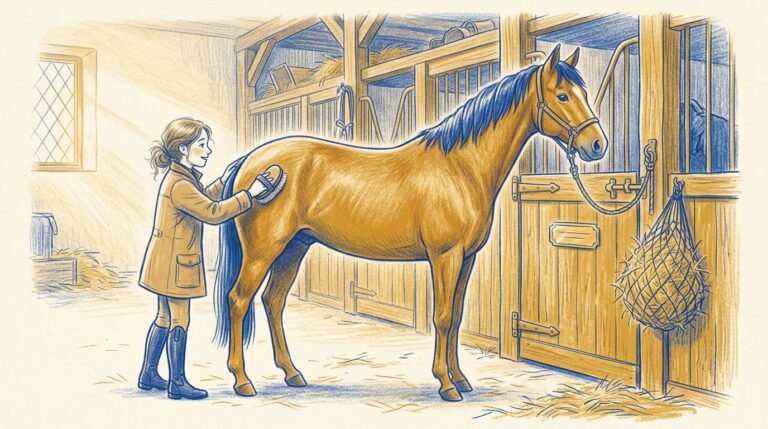
The curry comb goes on first. It loosens dried mud, dead hair, and dander from the coat. You work it in circles on the neck, shoulder, barrel, and hindquarters, and you skip the bony areas, the legs below the knee, and the face. A rubber curry is forgiving for beginners and gentler on horses with thin skin. The Oster Equine Care Series Rubber Curry Comb is inexpensive, durable, and widely available. It is not fancy but it does exactly what a curry comb needs to do.
After the curry comes the dandy brush. This is the stiff-bristled brush that flicks the loosened debris off the coat. It works fast and it works hard. The Haas Diva Dandy Brush is a German-made brush that professionals and amateurs both reach for because the synthetic bristles are firm enough to move dirt but not so coarse they raise welts on a clean-skinned horse. It is one of those tools that costs a little more up front and then just lives in your grooming bag for years.
The soft body brush finishes the coat. It smooths everything down and brings out the natural shine. After that you do the face with a smaller, softer brush dedicated only to that purpose. Most horses have strong opinions about their faces. Respect them.
The Best Grooming Brushes for Horses in 2026
Once you have the four essentials covered, you start to develop preferences. These are the specific brushes that have proven themselves across different coat types, different horses, and different seasons.
For a soft finishing brush that works on every coat type, the Haas Chevaux Body Brush is about as close to a standard as you will find in a serious barn. The bristles are a blend of natural and synthetic fiber that lays the coat flat and moves with the horse’s muscle contours. It is gentle enough for face work on a horse that tolerates it. It cleans easily, dries fast, and holds its shape over years of use.
For a dandy brush that can handle a horse coming in from a wet muddy field, the Tough-1 Stiff Bristle Dandy Brush is the practical choice. It is the kind of brush you keep in two places in case one disappears, which they do. It is not the most beautiful tool in the bag but it handles dried caked mud, which is most of what you are dealing with in spring and fall.
If your horse is body-clipped or has a fine thin coat, you want a separate soft brush dedicated to post-clip grooming. The Haas line and the Leistner line both make brushes designed for sensitive skin. Worth the investment if you have a horse that flinches at the standard dandy.
Building a Kit by Level: Lesson Kid Versus Horse Owner
A lesson kid does not need to own a full grooming kit. Most lesson barns provide brushes for students. But there is value in having your own, even at the lesson stage. You know where they have been. You can keep them clean. And the kid who arrives with their own kit has already started thinking about the horse as a responsibility, not just an activity.
For a lesson-level kit, buy a curry comb, one dandy brush, one body brush, a hoof pick, and a soft face brush. Keep them in a canvas tote or a small plastic tote with a handle. That is enough. Do not buy a twelve-piece grooming set in a branded bag. Those are almost always low-quality bristles in high-marketing packaging.
For a leaser or owner, the kit grows because the horse grows on you. You add a shedding blade for spring coat turnover, a mane and tail brush or a wide-tooth detangling comb, a sweat scraper, and a separate set of brushes designated for legs and hooves. You also learn which brushes your specific horse likes and which ones they pin their ears at. Horses have opinions and those opinions are data.
For a full understanding of what horse care really involves at the ownership level, our horse care basics guide for beginners walks through the daily, weekly, and seasonal routines that go alongside grooming.
Brush Care and Why It Matters
Grooming brushes collect what you brush off the horse. That sounds obvious but it gets ignored more than it should. A dandy brush full of old dried mud and loose hair is not grooming the horse, it is redistributing what is already on it. Wash your brushes. All of them. Regularly.
Most natural-bristle brushes can be washed with warm water and a small amount of dish soap or a purpose-made brush cleaner. Rinse them thoroughly and let them dry bristle-side down so water does not sit in the base and rot the wood or warp the handle. Synthetic brushes are more forgiving but still need regular cleaning.
A set of brushes that is kept clean lasts significantly longer than one that is not. We have brushes in rotation that are five and six years old because they have been maintained. That matters when you are buying quality tools instead of cheap replacements every season.
If you are also working through your general tack and equipment maintenance, our guide on cleaning and conditioning tack pairs naturally with brush care since you are often doing both on the same afternoon.
What to Skip and What to Spend On
Most starter grooming kits sold in sets are not worth the price of the bag they come in. The brushes are made to photograph well, not to work well. Synthetic bristles that are too soft do not move debris. Handles that are too small make your wrist ache after one horse. Skip the sets.
What is worth spending on: the body brush and the dandy brush. Those are the two tools that touch the horse most and where quality actually shows up in the finish of the coat and the response of the horse. A horse that tolerates or even enjoys grooming is a horse that is more relaxed before a ride. That is not nothing.
The curry comb is one place where you do not need to spend much. Rubber curries are cheap, effective, and nearly indestructible. The hoof pick is the same. Buy one with a brush on the back end. Keep it in your boot or in your back pocket during tacking up so you do not have to go looking for it before every ride.
For more on getting the right gear in the right order as a newer rider or horse family, our article on common horse health issues explains why good grooming practice is also your first line of observation for early signs of skin problems, thrush, and coat changes that signal something worth watching.
For broader research on equine nutrition and coat health from a veterinary standpoint, The Horse publishes peer-reviewed and vet-sourced content on everything from supplement effects on coat quality to skin conditions that grooming can aggravate if done wrong.
Frequently Asked Questions
What is the most important brush in a horse grooming kit?
If you can only have one, make it a rubber curry comb. It does the foundational work of loosening everything the other brushes then remove. In practice though, the dandy brush and body brush are what you use on every horse before and after every ride, so the real answer is that those three together are your core kit.
How often should you replace grooming brushes?
With regular washing and proper drying, a quality brush can last five years or more. Replace a brush when the bristles are flattened, missing, or no longer springing back after use. A brush that is not making contact with the coat is not doing anything useful.
Can you use the same brushes on multiple horses?
In a lesson barn, shared brushes are common and that is the reality. For owned or leased horses, dedicated brushes are the cleaner option because skin conditions and fungal issues like rain rot can spread on shared equipment. At minimum, if brushes are shared, wash them between uses and do not share brushes used on a horse with any known skin issue.
Do horses actually have preferences about grooming brushes?
Yes. Some horses are sensitive-skinned and reactive to stiff bristles on certain areas. Some are almost indifferent. Pay attention to ear position and muscle tension during grooming. If a horse pins its ears every time the dandy brush hits its flank, try a softer brush on that area. It is information. Use it.
The Kit That Works Is the One You Actually Use
Grooming is not glamorous. It is the part of horse ownership that happens in the cold and the dark and the mud before anyone takes a single step toward the arena. But it is also where you learn the horse. You notice the new scrape, the slight heat in a leg, the dull patch in the coat that was not there last week. The best grooming brushes for horses are the ones that fit your hand, suit your horse, and hold up across seasons of real use.
Start with the essentials. Buy quality on the two or three tools that matter most. Keep everything clean. That is the whole job.
If you want a simple reference to take to the barn, grab our free printable grooming checklist and then head over to the shop for more gear recommendations we actually stand behind.