How to Teach a Horse to Stand for Mounting
If you want to know how to teach a horse to stand for mounting, you are already asking the right question. A horse that walks off the moment your foot hits the stirrup is not just annoying — it is a genuine safety problem, and it does not fix itself by ignoring it or muscling through. This is one of those foundational ground manners issues that touches every single ride. Get it right and everything downstream gets easier. Skip it and you are fighting the same battle every time you swing a leg over.
The Riding Life is reader-supported. When you buy through links on our site, we may earn an affiliate commission at no extra cost to you.
Why Horses Walk Off at the Mounting Block in the First Place
Before you can fix the problem, it helps to understand what is actually happening. Most horses that will not stand for mounting are not being deliberately difficult. They have learned, usually through accidental repetition, that the moment a rider settles into the saddle, something is about to happen — movement, pressure, work — and so they get a head start on it.
Sometimes the rider is part of the cause. If you are quick to ask for a walk-on the instant you are seated, the horse learns that stillness after mounting is not the expectation. If the mounting block is positioned poorly and the horse has to hold an awkward angle to stand next to it, you are asking them to be uncomfortable to accommodate you. If tacking up is rushed and the girth is too tight too fast, the horse arrives at the mounting block already tense. The horse is not misbehaving. It is responding to the pattern it has been taught, even if no one meant to teach it.
There are also horses that have had a rough mounting experience — someone who grabbed the saddle and yanked, a girth that pinched, a rider who landed hard in the saddle — and those horses carry that memory forward. Signs your horse is in pain during grooming or tacking up can sometimes show up as resistance at the mounting block. Worth ruling that out before you chalk it up to attitude.
How to Teach a Horse to Stand for Mounting Step by Step
The method is simple. The patience required is less simple. Here is how to work through it.
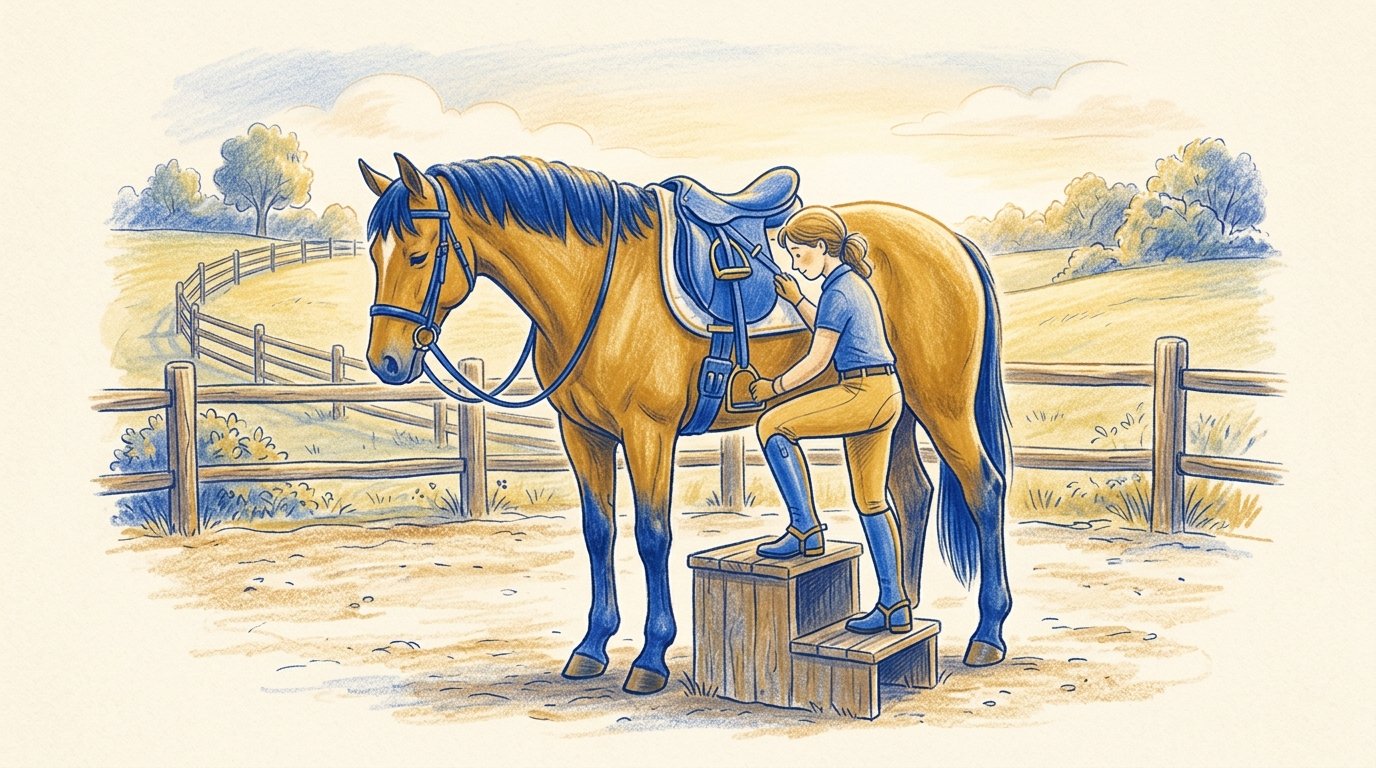
Start with the mounting block, every time. If you have been mounting from the ground, stop. Ground mounting torques the saddle sideways and puts uneven pressure on the horse’s back. A mounting block is not a crutch — it is better for the horse and better for your tack. Position the block so the horse can stand straight alongside it, not at an awkward angle.
Bring the horse to the block and ask for stillness before you do anything else. Lead the horse up, position it, and then just stand there. Do not get on. If the horse moves, quietly reposition it back to the block without drama or punishment. Repeat until the horse stands without fidgeting. This step alone, done every day, builds the expectation that the mounting block means stand and wait.
Add pressure gradually. Once the horse stands quietly with you beside the block, put your foot in the stirrup without mounting. Hold it there. If the horse moves, remove your foot, reposition, and start again. When the horse holds still, reward it immediately — a release of pressure, a soft word, a rub on the neck — and step down. Do not always get on. Vary it so the horse does not anticipate what comes next.
Mount and sit quietly before asking for anything. When you do get on, sit still. Do not immediately pick up the reins and walk on. Sit there for fifteen or thirty seconds. Let the horse understand that mounting does not automatically trigger movement. This is the part that most riders skip because it feels unproductive, but it is arguably the most important piece. You are rewriting the pattern the horse has learned.
If the horse moves while you are mounting, do not just go with it. Halt. Back up a few steps. Return to the mounting block and start over. The horse needs to learn that walking off does not get it anywhere faster. This is not punishment — it is just a clear, consistent consequence. The lesson is: stillness gets you a rest, moving off gets you more work.
Building the Habit Over Time
One session will not fix a horse that has been walking off for two years. Plan on consistent work over weeks, not days. The good news is that this is not strenuous training — you can work on it every single time you ride, which means you are reinforcing it constantly without adding extra sessions to your schedule.
A few things that make the process easier:
Lunge first if the horse is fresh. A horse with too much energy is a horse that cannot concentrate. Taking the edge off on the lunge line before you ask for mounting-block work is not cheating — it is management. How to lunge a horse is worth reading if you are newer to the process.
Check your girth tightening routine. Horses that are girthy often arrive at the mounting block tense. Tighten gradually — a few holes at a time, with walking in between — rather than all at once before you head out.
Look at your saddle fit. A saddle that pinches when the rider sits down will produce a horse that does not want to be sat on. Saddle fit is not a one-time box to check; it should be evaluated regularly, especially if the horse’s condition changes.
Be consistent with every handler. If you are working on standing at the mounting block but other riders or barn staff let the horse walk off, the training gets diluted. Everyone who mounts that horse needs to be on the same page.
Ground Manners as the Foundation
Standing for mounting is really a ground manners issue that happens to involve a rider. A horse that has solid ground manners — that leads quietly, stops when asked, moves its feet when you say move and holds still when you say stand — is a horse that is going to be much easier to work with at the mounting block. If you are fighting the mounting block battle and also struggling with leading, tying, or general barn behavior, the mounting block is probably not where to focus first.
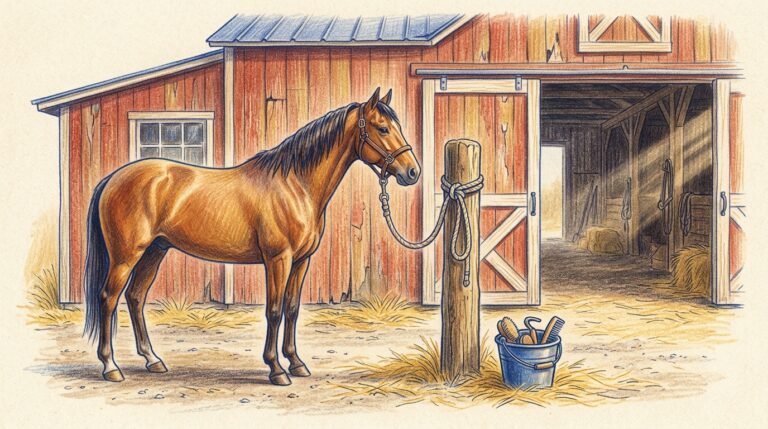
How to safely tie a horse is a good starting point if you are building these ground habits from scratch. A horse that stands tied without pulling back has already learned that pressure and patience go together. That same understanding transfers directly to mounting-block work.
Groundwork does not have to be elaborate. The basics — walk, halt, back, stand — done consistently from the ground translate to a calmer, more responsive horse when you get to the mounting block and eventually to everything under saddle.
For riders who want to go deeper into the ground manners and training philosophy side of this, The Horse has solid, research-backed resources on equine behavior that can help you understand the why behind the training approach.
Gear That Makes Mounting Safer and Easier
The equipment around the mounting process matters more than people think. A good mounting block is obvious, but the gear on you matters too. If your boots do not have a proper heel, your foot can slip through the stirrup — which is dangerous at any moment, but especially during mounting when you are partially weighted and off-balance. If your half chaps are bunching at the ankle, you have a distraction you do not need.
On the horse’s side, a properly fitted saddle and a correctly adjusted stirrup length change how easy it is to mount cleanly and land softly in the saddle. A clunky, hard landing trains a horse to brace for impact. You want to be light and controlled from the moment your foot touches the stirrup. For riders sorting out their stirrup setup, this stirrup length guide is a practical reference.
If you are doing a lot of ground work and handling as part of this training, consider a pair of gloves with real grip. The Roeckl Chester Riding Gloves are a legitimate everyday barn glove — durable, grippy, and they do not make your hands feel like oven mitts in warmer weather.
Frequently Asked Questions
How long does it take to teach a horse to stand for mounting?
It depends entirely on how long the bad habit has been reinforced and how consistent you are about fixing it. A horse that has only been walking off for a few months may come around in a few weeks of steady work. A horse that has been doing it for years will take longer. Work on it every single ride and you will see progress. Skip sessions or let it slide and you will keep starting over.
Should I use treats to teach a horse to stand at the mounting block?
Some horses respond well to treat-based positive reinforcement and some get mouthy and distracted by it. If you use treats, the timing of delivery matters — the treat should come when the horse is standing still, not when it has just moved. A lot of riders find it cleaner to use release of pressure and a quiet rub as the reward, especially when you are asking for stillness rather than an active behavior.
My horse stands fine with the trainer but walks off when I get on. What am I missing?
This is very common and the answer is usually in the details of how you approach and mount. Watch how your trainer positions the block, how they handle the reins, how quickly they ask the horse to move off after mounting. Horses read body language and energy before you ever put a foot in the stirrup. If you are rushing or nervous, the horse feels it. Slow down your whole approach and see if it changes.
Is it ever a pain issue if a horse will not stand for mounting?
Yes, and it is worth ruling out before you invest a lot of training time. Hock soreness, back pain, a poorly fitted saddle, or even a girth that pinches can all make a horse want to get away from the pressure of mounting. If the behavior came on suddenly or is paired with other signs of discomfort, get a vet look before you assume it is a training problem.
The Bottom Line on Teaching a Horse to Stand for Mounting
Learning how to teach a horse to stand for mounting is not complicated, but it requires patience, consistency, and the willingness to go back to the beginning every time the horse gets it wrong without getting frustrated about it. The horse is not trying to make your life difficult. It has learned a pattern. Your job is to teach it a different one, clearly and without drama, until the new pattern is the one that sticks.
Do the work at the mounting block before every ride. Check your own habits and equipment. Make sure the horse is comfortable in its tack. And then be patient, because this is the kind of foundational barn work that pays off quietly — in every ride, for years.
If this kind of practical barn advice is useful to you, grab our free printable checklist to keep the basics organized, and head over to the shop to see what else we have put together for horse families doing the real work every day.