Riding Arena Footing Types Explained for Horse Owners and Barn Families
If you have spent any real time at barns, you have noticed that not all arenas feel the same under a horse. Some are grippy and springy, some are slick, some are deep and grabby in a way that will blow a tendon if you are not careful. Riding arena footing types matter more than most people outside the horse world realize, and if you are looking at boarding, building, or even just choosing a lesson barn, understanding what is under your horse is worth your time. Good footing protects legs. Bad footing costs money in vet bills. That is the entire argument.
The Riding Life is reader-supported. When you buy through links on our site, we may earn an affiliate commission at no extra cost to you.
Why Riding Arena Footing Types Matter More Than the Jump Standards
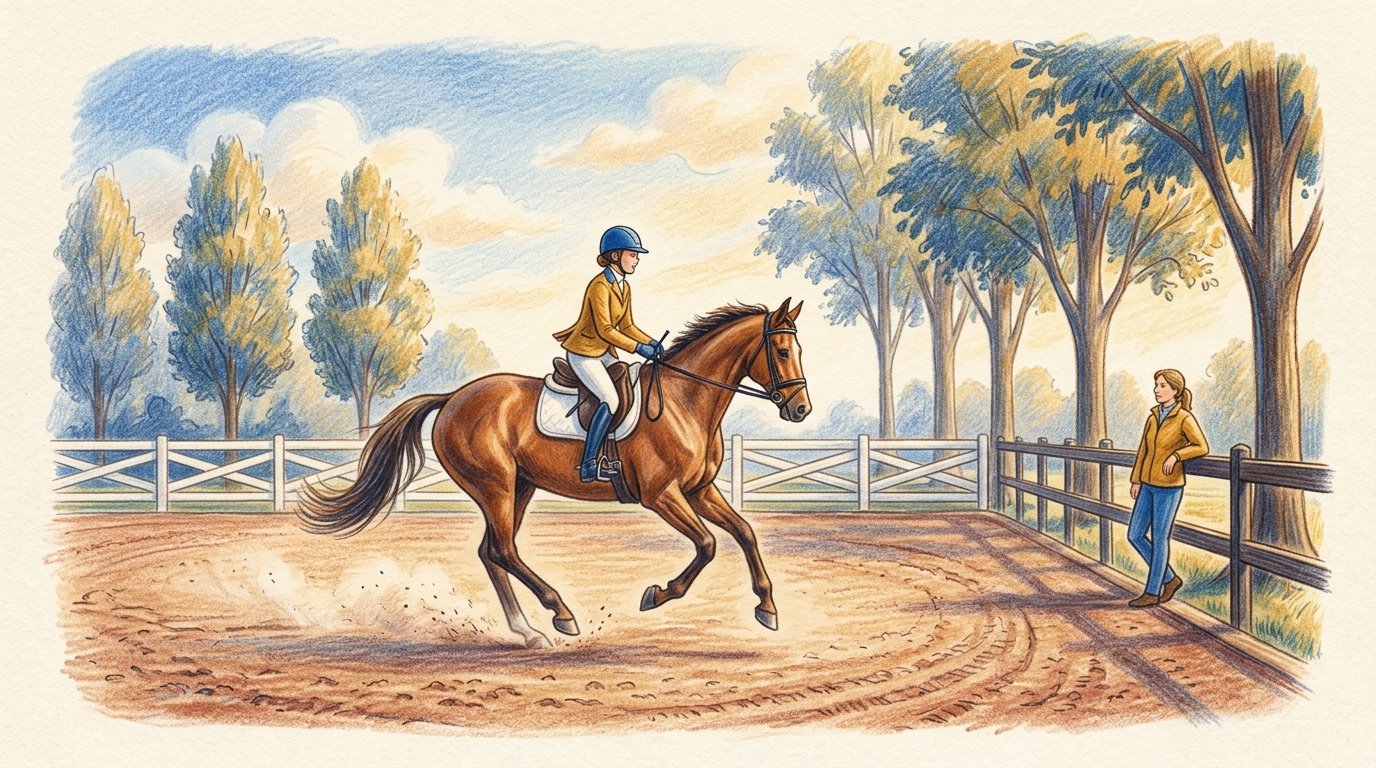
I have watched enough horses come up lame at shows and at home to develop strong opinions about arenas. The footing is not a detail, it is the foundation of every single thing that happens in that space. The horse is always working through the surface, whether it is doing flatwork, jumping a small course, or just being longed. When the footing is off, the horse compensates, and compensation over time becomes injury.
From the parent-side-of-the-rail perspective, we tend to focus on the things we can see: the horse, the rider, the course. The ground beneath all of it does not get its due until something goes wrong. A horse that slips in a wet or dusty arena, a horse whose joints absorb shock differently because the sand is packed too hard or too deep, a horse that pulls a suspensory because the surface grabbed a foot at the wrong moment. These are not rare events. They happen at real barns, and they are often preventable.
Good arena footing also affects the rider’s learning. A surface that gives the horse consistent traction lets the animal move correctly, which means the rider can actually feel correct movement and develop the muscle memory for it. If the footing is unpredictable, the horse is guarded in its movement, and the rider never gets to feel what a real free-moving trot or an open canter actually feels like. That matters when you are paying around a hundred dollars a week for lessons and trying to make every ride count.
You can read more about what goes into that weekly lesson investment over at our guide on how much horseback riding lessons cost.
The Most Common Riding Arena Footing Types Broken Down
There are more options on the market than there used to be, and the industry has moved toward engineered blends rather than pure natural materials. Here is what you are most likely to encounter at a working barn or consider for a home arena.
Sand is the baseline. It is affordable, easy to find, and most arenas have some percentage of sand in them. The problem with plain sand is that it compacts, it gets deep when it dries out and loose when it is wet, and fine silica sand generates dust that is bad for equine lungs and human ones too. The particle size and shape matter enormously. Angular sand compacts less than round sand. Mason sand behaves differently from river sand. If a barn tells you they have a sand arena, the follow-up question is what kind and what size.
Rubber footing, meaning crumb rubber or shredded rubber often recycled from tires, gets mixed into sand to add cushion, reduce compaction, and cut down on dust. It is one of the more common additives in lesson barns and boarding operations that want a low-maintenance surface. The ratio of rubber to sand matters. Too much rubber and the footing becomes too soft and springy, which puts stress on tendons in a different way. The right blend, usually somewhere around ten to fifteen percent rubber by volume, gives you a surface that cushions impact without being grabby.
Fiber footing uses shredded synthetic textile, geotextile fabric strips, or similar materials mixed into the base. Fiber helps bind the surface particles together so they do not separate as quickly, reduces dust, and maintains consistent depth better than plain sand under heavy traffic. Wax-coated fiber blends are used in high-end competition arenas. They are excellent but expensive upfront. You will see these at some of the larger venues where the footing quality is advertised as a selling point.
Screenings and stone dust, also called decomposed granite in some regions, are used more often in western disciplines and trail-type arenas. They pack firm and drain reasonably well. They are not ideal for jumping or for horses with joint issues because there is very little cushion. Fine for light flatwork or a smaller barn operation on a budget.
Polymer and wax-coated sand blends are the premium indoor arena standard at this point. The coating reduces dust, stabilizes moisture levels, and keeps the surface consistent across seasons. The upfront cost is significant, but the maintenance requirements drop considerably compared to plain sand. If you are at a barn that has invested in a wax-coated surface, you will feel the difference the moment the horse moves out in a trot.
Outdoor Versus Indoor Arena Footing Considerations
The same material does not always behave the same way in both settings, and that is worth knowing before you commit to anything.
Outdoor arenas are at the mercy of weather. Rain compacts and displaces footing, dry heat turns it to dust, freeze-thaw cycles in northern climates heave and shift the base. Any outdoor arena footing plan has to account for drainage first. A proper base layer, usually compacted stone or road base, with a crown or slope to shed water, is what determines whether your surface stays rideable after rain or turns into a mud pit. The footing on top is only as good as what is under it. We have seen more than one barn skip the base work to save money and regret it within the first winter.
Indoor arenas have the advantage of weather control but their own set of issues: dust management becomes critical because the air does not circulate the way it does outside, and moisture control is harder when you cannot rely on rain to settle the surface. Many indoor arenas use watering systems, either overhead misters or drag-attached sprayers, to manage moisture. If you are boarding at a barn with an indoor and the footing is chronically either too deep and soft or packed and hard, ask how often they water and how often they drag.
Dragging is maintenance, full stop. Even perfect footing becomes dangerous if it is not groomed regularly. An arena that gets dragged daily before use is a different surface than one that gets dragged weekly. This is one of those barn-management details that you learn to ask about once you have been around long enough.
For a broader look at what good horse care infrastructure looks like day to day, our horse care basics for beginners guide covers the fundamentals.
What to Ask When Evaluating a Barn’s Arena Footing
Whether you are choosing a lesson barn, a boarding facility, or a venue for a show, these are the questions worth asking out loud.
What is the base material and how deep is the riding surface? Too shallow over a hard base and the cushion is inadequate. Too deep and the horse is working harder than it should, which fatigues the soft tissue structures in the lower leg. For most disciplines, two to four inches of properly maintained footing over a solid base is the target range.
How is the moisture managed and how often is it dragged? These two things together determine whether the listed footing type is actually performing the way it should.
Has the footing been tested or inspected? The The Horse publication and similar veterinary resources have written about the measurable impact of footing on equine joint health. Some competition venues use footing assessment tools that measure firmness and consistency. It is not overkill to ask if a professional has ever evaluated the surface.
Is it consistent across the whole arena? Corners that compact differently than the center, a soft spot near the gate, a hard patch under the jumps where the horse always lands. A good arena manager knows where the problem spots are and addresses them. A bad one does not know they exist.
If you are thinking about the bigger financial picture of horse ownership and where arena access fits into the cost structure, our piece on leasing a horse versus buying lays out the whole comparison honestly.
Building or Improving Your Own Arena Footing
If you are at the point where you are building a home arena or improving what you have, the order of operations matters. Start with drainage and base before you spend money on surface material. A proper compacted base, graded for drainage, will cost real money but it is the foundation everything else depends on. Skipping it to put a nicer surface on a poorly draining base is the equivalent of putting good tires on a car with a bent frame.
For a home arena on a modest budget, a quality angular sand mixed with crumb rubber is a reasonable starting point. Get quotes from local aggregate suppliers, not just equestrian specialty companies, because the same materials are often sold under different names at significantly different prices. If you want to step up from there, adding fiber to the mix will help with stability and dust. Full wax-coated systems are an option if the budget allows, but they require specific maintenance tools and procedures to stay effective.
Budget for ongoing maintenance: a three-point drag or arena groomer, a water source, and the time to use both regularly. The footing you install is only the beginning. What you do to it every week is what determines whether it stays good.
Keeping good records of your arena maintenance, your vet visits, your farrier schedule, and your footing work is part of managing any horse property well. Our barn chore schedule for horse owners is a useful framework for staying on top of all of it.
For additional technical guidance on footing standards at the competition level, USHJA publishes resources on hunter and jumper venue standards that are worth reading if you are hosting shows or competing seriously.
Frequently Asked Questions
What is the best footing for a horse arena?
There is no single answer because it depends on your discipline, climate, budget, and how much maintenance you can commit to. For most English disciplines including hunters, jumpers, and dressage, a quality angular sand and rubber blend, two to four inches deep over a properly drained base, is a solid and realistic standard. For western and trail, packed decomposed granite or screenings work well for light use. If budget allows, wax-coated fiber and sand blends perform best across seasons and disciplines.
How deep should riding arena footing be?
For most riding disciplines, two to four inches of working surface over a firm compacted base is the general target. Less than two inches and you lose cushion, especially important for jumping. More than four inches and the horse is overworking its soft tissue structures with every stride. Deep footing is not soft and safe, it is fatiguing and potentially injurious over time.
How often does arena footing need to be dragged?
In a busy barn, the arena should be dragged before or after every heavy use session, which in practice means daily or close to it. At minimum, a working arena should be groomed two to three times a week. Dragging redistributes displaced material, breaks up compaction, and keeps the surface depth consistent. Neglecting it lets problem spots develop and the surface deteriorates faster regardless of what it is made of.
Is crumb rubber footing safe for horses?
Crumb rubber, typically recycled from tires, has been used in equestrian arenas for decades and is widely accepted as safe when properly blended with sand. The concerns about chemical leaching that exist in other rubber recycling applications have not translated into documented equine health problems at the ratios used in arena footing. That said, some barn owners and riders prefer synthetic fiber alternatives if they want to avoid rubber entirely. It is a reasonable preference, not a necessity.
The Bottom Line on Riding Arena Footing
Footing is infrastructure. It is not glamorous, it does not photograph well, and nobody at a show is complimenting the arena base drainage. But it is the thing that keeps horses sound and riders safe, and it is worth understanding whether you are choosing a barn, maintaining your own property, or just trying to ask smarter questions at the facilities where your horse works.
Good footing is consistent, appropriate depth, well-drained, and regularly maintained. That is the whole standard. Everything else, the material type, the additives, the brand of engineered blend, is in service of those four things.
The barn is always more expensive and more complicated than it looks from the outside. Knowing what to look at and what to ask is how you protect your investment and your horse’s legs. Start there.
If this was useful, grab our free printable checklist to help you evaluate and maintain your arena footing, and head over to the shop for more resources built for real barn families doing this work every day.