Barn Cat Benefits for Horse Owners
Why Every Working Barn Needs a Cat
The barn cat benefits for horse owners are more practical than most people give them credit for, and if you have spent any real time around a working stable, you already know this. Rodents are a constant in any place where hay and grain are stored. They chew through bags, contaminate feed, gnaw electrical wiring, and bring disease into an environment where your horse is already a fragile enough creature without added health risks. A good barn cat addresses all of that without a monthly pest control bill. This is not sentimental. It is barn management.
The Riding Life is reader-supported. When you buy through links on our site, we may earn an affiliate commission at no extra cost to you.
Rodent Control Is the Main Event
Let us be direct about what a barn cat actually does, because the romanticized version — cat curled up on a hay bale, decorative and charming — is only part of the story. The working part happens at night, in the corners of the feed room, in the gaps between stacked hay bales, along the wall where the grain bins sit. A single adult cat with reasonable hunting instincts can eliminate dozens of mice per week. That is not an exaggeration. University extension programs on livestock facility management have documented this for decades.
Why does this matter to your horse specifically? Mice and rats contaminate hay and grain with urine and droppings. Rodent contamination in horse feed is a real disease vector. Rats in particular can carry leptospirosis, which horses can contract. Beyond disease, rodents chew through electrical wiring in barn aisles and stalls, creating fire hazards that are slow to develop and fast to destroy everything. A barn cat does not eliminate all of this risk, but a committed hunting cat significantly reduces the rodent population, which reduces every downstream risk that comes with it.
Two cats are generally more effective than one, particularly in a larger barn. They cover more ground, they reinforce territorial behavior, and if one cat is sick or aging, you are not left completely uncovered. Most experienced barn managers will tell you the same thing.
Feed Room and Hay Storage Protection
Your hay and grain are your second-biggest monthly expense after board, or close to it. If you own your horse and you are buying hay in quantity, protecting that investment matters. Rodents do not just eat what they consume in one sitting. They gnaw through bale twine, burrow into round bales, and leave contamination throughout. You lose feed you paid for, and you also have to make judgment calls about what is safe to feed and what needs to be pulled.
Grain bags that are not stored in sealed metal bins are particularly vulnerable. We have seen entire fifty-pound bags compromised in a week by a persistent mouse problem. A barn cat patrolling the feed room changes that calculus. Mice do not set up permanent residence in spaces where a predator is actively working.
Good metal feed bins are still worth having regardless of whether you have a cat. The combination of a well-secured grain room and a hunting cat is better than either alone. If you are building out or reorganizing your storage setup, our guide on how to organize a tack room covers storage thinking that applies equally well to feed areas.
Barn Cat Benefits for Horse Owners Beyond Pest Control
There are secondary barn cat benefits for horse owners that do not get discussed as often, but they are real.
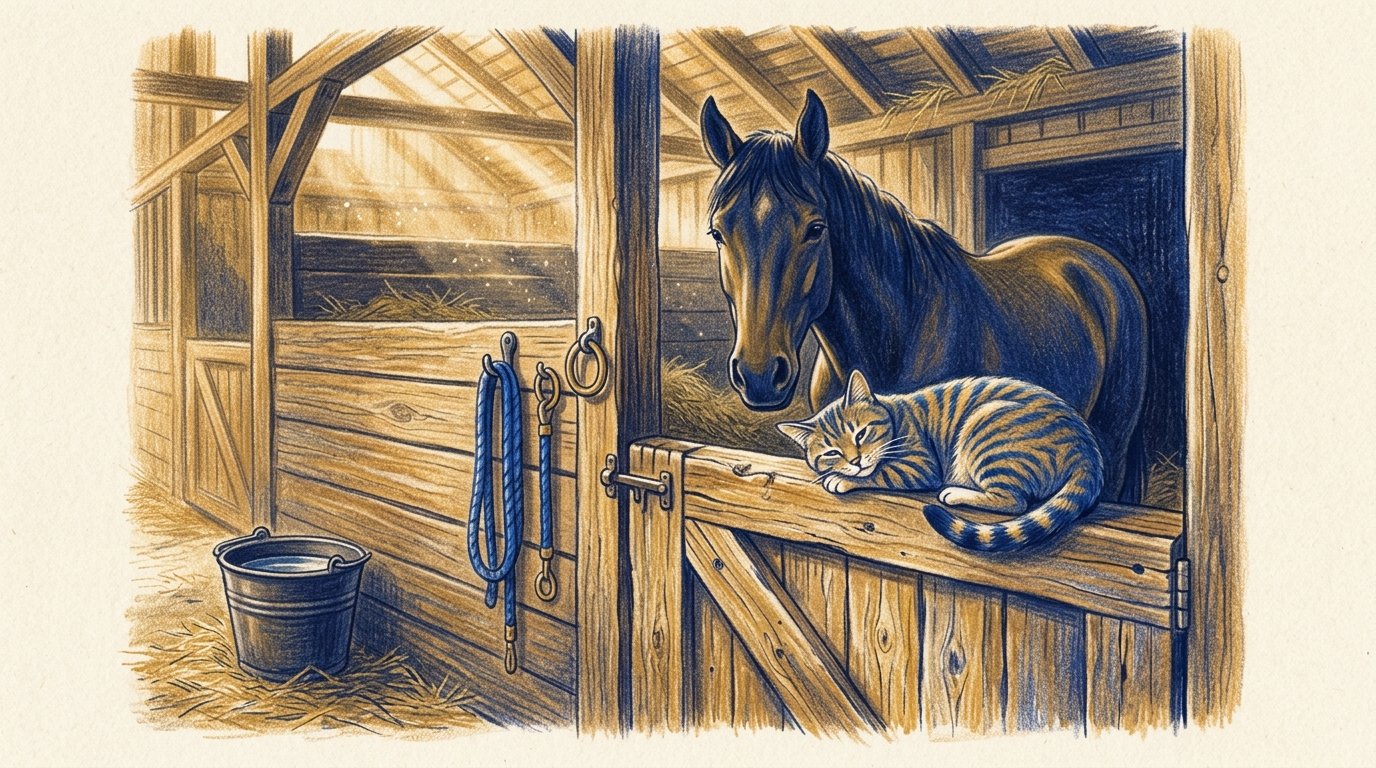
Horses that are routinely exposed to cats from a young age are generally calmer around them. A horse that has grown up seeing a barn cat weave between its legs at feeding time is not going to spook when a cat drops off a hay bale. This kind of low-level desensitization to small, quick-moving animals is useful. It does not replace intentional desensitization work, but it contributes to a horse that is accustomed to the unpredictable things that happen in a barn environment. That matters on show days, on trail rides, and in any situation where a startled horse is a dangerous horse.
There is also something to be said for barn morale, and I mean that in a non-sentimental way. A barn that is overrun with mice is an unpleasant place to work. The sounds, the droppings, the damage — it wears on the people who spend hours there every week. A barn with a functioning cat population feels different. People linger a little longer. The atmosphere is better. That might sound soft, but the people who keep a barn running — the working students, the dedicated boarders, the lesson families who show up twice a week — they notice when a barn is well-managed versus when it is losing the battle against vermin.
If you want to read more about what a well-run barn daily routine actually looks like, barn chores daily routine covers the ground-level reality of what keeping horses well requires, day in and day out.
How to Integrate a Barn Cat Responsibly
A barn cat is not a pet you drop off and forget. This is where a lot of people make the mistake. They adopt a cat, release it into the barn, and consider the job done. That is how you end up with a feral, unhealthy animal that either dies or disappears.
A few things matter for a barn cat to actually function well over the long term.
Spay or neuter. This is non-negotiable. An intact cat population in a barn explodes fast, and you will have more cats than you can manage or provide for within a season. Spayed and neutered cats are also generally calmer, more territorial in a productive way, and longer-lived.
Core vaccinations. Barn cats need rabies vaccines and basic preventive care. They are outdoors, they are hunting, they are exposed to wildlife. A cat bite from a bat or a skunk is a serious situation, and an unvaccinated barn cat complicates that significantly. Budget for annual vet care the same way you budget for farrier visits. It is not optional.
Supplemental feeding. A hunting cat still needs supplemental food, particularly in seasons when prey is scarce. A hungry cat is not a more effective hunter — it is a stressed animal that may leave to find a better situation. Keep dry food available. It does not reduce hunting drive the way some people claim; it keeps the cat healthy enough to do its job effectively.
Shelter and water. A cat box with bedding in the tack room or feed room, a water source that does not freeze in winter, and access to the barn aisle at night when hunting is most productive. These are basic requirements, not luxuries.
If you want a thorough look at what horses need in terms of daily care basics, horse care basics for beginners is a good starting point for understanding the larger care ecosystem the barn cat fits into. For broader reading on barn animal health and management, The Horse covers feline-equine cohabitation topics and disease prevention in depth.
Frequently Asked Questions
Are barn cats safe around horses?
Yes, in almost every case. Horses that are exposed to cats regularly become habituated quickly. Initial introductions should be calm and gradual, especially with horses that have never encountered cats before. Most horses adjust within days to weeks. A cat that has been raised in a barn environment is already skilled at reading horses and staying out of the way of hooves.
How many barn cats do I need?
For a small barn of four to six stalls with a modest feed room, one confident hunting cat can do meaningful work. For larger operations with extensive hay storage or more square footage, two cats are a more realistic baseline. More than three or four cats in a small barn creates management and health challenges that outweigh the benefit.
What do I feed a barn cat?
A quality dry kibble left available at all times works well for most barn cats. Supplement with wet food during winter when prey is less available. Keep the food in a sealed container to avoid attracting the very rodents you are trying to eliminate. Elevate the food dish if possible to reduce contamination from droppings and debris.
Can a barn cat get sick from rodents it catches?
Yes, which is why vaccinations matter. Cats can contract certain parasites and diseases from rodents they hunt and consume. Core vaccines, routine deworming, and annual vet checks keep this risk manageable. This is not a reason to skip the barn cat — it is a reason to keep the barn cat healthy so it can do its job for years.
The Bottom Line on Barn Cats
The barn cat benefits for horse owners come down to this: a well-cared-for barn cat is one of the most cost-effective tools in a horse owner’s management toolkit. It protects feed, reduces disease risk, contributes to a calmer barn environment, and does its best work while you are asleep. The investment is spay or neuter surgery, annual vet care, and a bag of kibble. The return is a barn that runs cleaner and costs less to operate over time.
We are not suggesting a barn cat replaces solid feed storage, proper rodent-proofing, or good sanitation. It does not. But it is a meaningful piece of a larger system, and most experienced horse owners who have had a working barn cat will tell you they would not run a barn without one.
If this kind of practical, ground-level barn management thinking is useful to you, grab our free printable barn management checklist and browse the shop for more resources built for horse families who live this life every day, not just dream about it.